The limit of AI automation in B2B sales isn’t where most people think it is
Most posts about AI in B2B sales arrive at the same sentence: AI can automate a lot, but it won't replace the human. That's probably true. It's also nearly worthless as a statement, because nobody seriously disagrees, and nobody can act on it.
The interesting question isn't whether the limit exists. It's exactly where it sits. And it doesn't sit where most people assume.
The wrong dividing line
The intuitive assumption: AI takes the simple, repetitive tasks, the human handles the rest. Automate first contact, automate qualification, and eventually all that's left for the human is the demanding negotiation.
That sounds plausible. It's the wrong dividing line. It sorts by task complexity — easy versus hard. The actual limit doesn't run there.
Where the limit actually sits
For a high-value B2B product in the five- to six-figure range, a single person almost never makes the purchase decision. There's a buying center: someone identifies the need, someone owns the budget, someone checks terms and compliance, often a technical reviewer weighs in too. That's not an edge case for expensive deals — it's the norm once a certain price threshold is crossed.
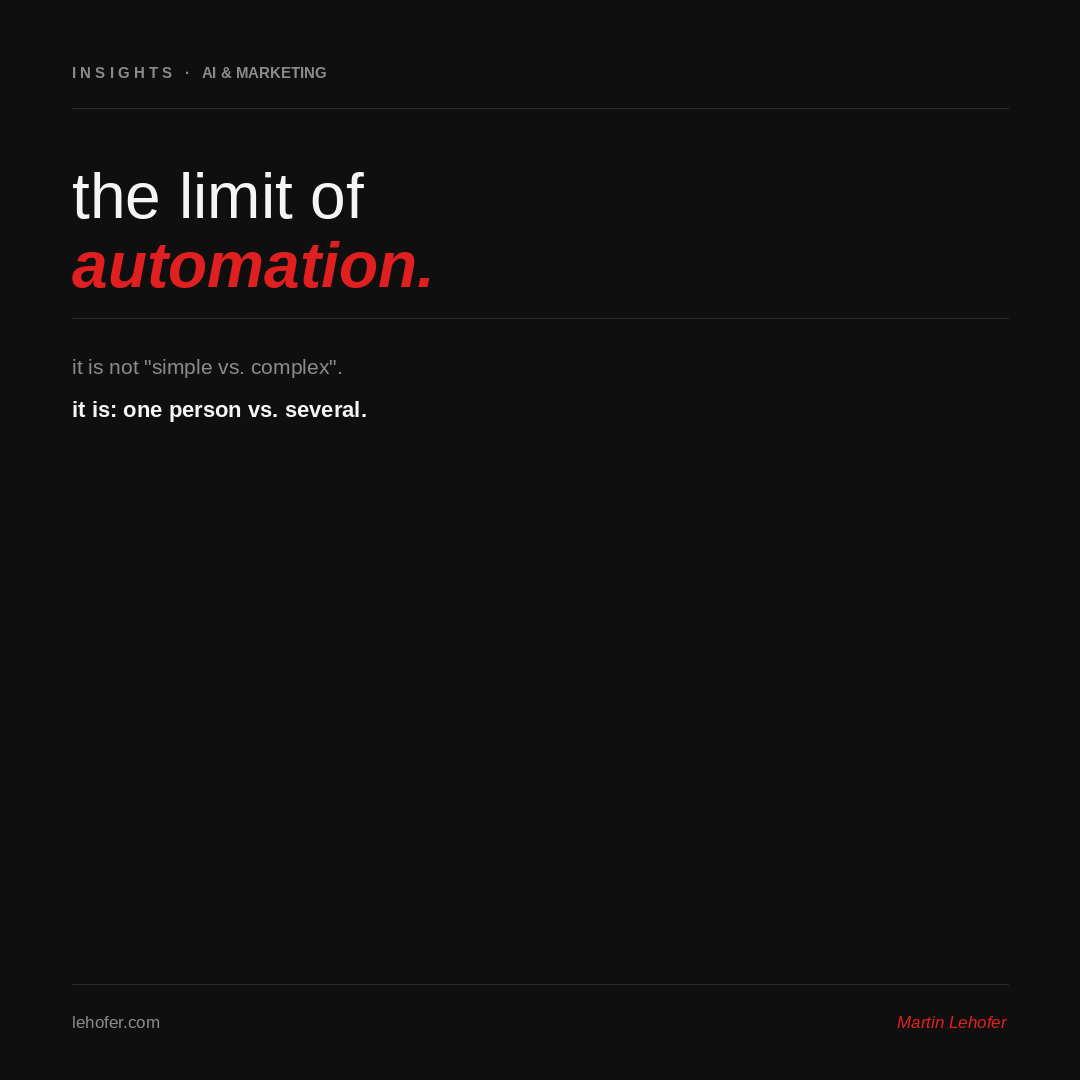
That's precisely where the real automation limit runs. Not "simple versus complex," but "one person decides versus several people decide together."
Everything before that point can be meaningfully supported: a contact gets identified, a system detects deeper interest based on behavior, a tool preps the first conversation, summarizes it afterward, pulls together relevant context. That's real time saved, not a claim.
But once several people with different interests have to jointly carry a decision, the nature of the task changes fundamentally. It stops being an information problem you can solve with better preparation. It becomes a trust problem between multiple people, each carrying personal risk if the decision later turns out to be wrong. That kind of trust doesn't come from better data packaging. It comes from someone in the room, answering questions live, visibly taking responsibility, and personally standing behind the decision if it's challenged later.
The limit isn't gradual, the way "simple versus complex" logic suggests. It's a clean break: up to a certain point in the process, automation carries real weight. Past that point, it structurally doesn't — regardless of how good the technology gets.
What this means for B2B marketing
Anyone planning AI deployment in their own sales process shouldn't ask which tasks are "simple enough" to automate. The right question is: at what point in your own sales process does a single person stop deciding alone? Everything before that is automation territory. Everything after it structurally isn't, no matter how the technology advances.
That's also a relief, not just a constraint. Once you know where the limit sits, you don't have to keep re-evaluating whether the next AI tool will finally replace the human negotiation after all. The answer doesn't depend on the tool. It depends on the purchase decision structure of the product in question — and that doesn't change just because the technology gets better.
Martin Lehofer is a Marketing & Growth Leader focused on B2B technology in the DACH region. At lehofer.com, he writes about GTM strategy, positioning, and the role of AI in enterprise sales.