I built a BI chatbot in 2015. Nobody called it AI back then.
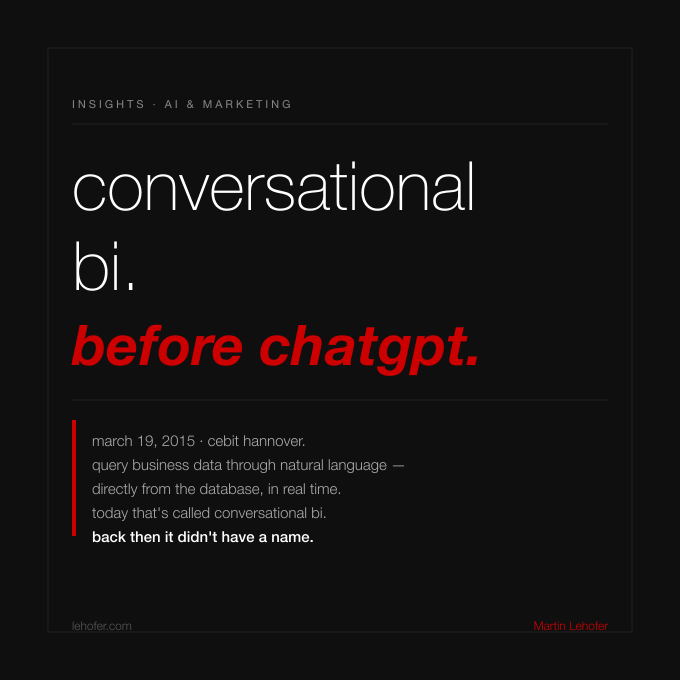
On March 19, 2015, I spent my 40th birthday at CeBIT.
Not because I had to. But because that day we presented something I’d been pushing through internal resistance, escalations, and endless alignment loops for over a year: a BI chatbot. A system that made enterprise data queryable through natural language — directly from the database, in real time, via a messenger app.
Today that’s called conversational BI. Back then it didn’t have a name.
The idea was clear. The execution was not.
The CEO had a precise vision: anyone with a question should be able to ask it. Like on a phone. No training, no click paths, no dependency on someone who first has to build the report. He tasked me with the project — directly, bypassing the usual structures.
Technically, that meant: a chat interface with natural language input, connected to a multidimensional database responding in real time to parametrized queries. No static dashboard. No export. A direct answer to a direct question.
This was early 2014. GPT-3 came in 2020. ChatGPT in 2022.
The real problem was internal
My role was business-side project lead: define requirements, steer development, build the marketing, manage the pilot customer. No code. But full accountability.
And a lot of people didn’t like that.
The project came directly from the CEO — not from the dev team, not from product management. It had no organic backing in the organization. The result: missing cooperation, delayed deliverables, escalations that had to be taken all the way back to the CEO multiple times.
What I learned from this: technical innovation rarely fails because of the technology. It fails because of ownership. People who don’t want a project find ways to slow it down — without ever saying no.
From idea to pilot customer
The product was called C8 Snack internally — the world’s first instant BI reporting service via a messenger app. Not AI in today’s sense — no neural networks, no language model. Rule-based language processing with a structured database query behind it. But the result was functionally identical to what’s marketed today as conversational BI: a natural language interface to enterprise data.
I built the entire product marketing: positioning, messaging, sales enablement materials, presentations. And I managed the first pilot customer in the medical devices sector — ERP system connected to the BI platform, live sales tracking for a newly launched product, worldwide, in real time.
On March 19, 2015 — my 40th birthday — we presented it at CeBIT. Hannover, world’s largest IT trade show at the time, strong press coverage.
Cubeware officially launched C8 Snack on April 23, 2015. I was already on it before it had a product name.
What this means, looking back
I’m not telling this story to claim I invented ChatGPT. That would be absurd.
But I’m telling it because it reveals a pattern I’ve observed repeatedly since: the technological concepts being called disruption today were sitting in someone’s drawer long before. What brings them into the world is rarely the invention — it’s the willingness to execute in a moment when the infrastructure isn’t ready, the skepticism is high, and the internal support is missing.
In 2015, the infrastructure was too weak for what we built. The language processing was rule-based, not generative. The model had to be explicitly trained on which query patterns were meant. Scalability was limited.
Today I’d build the same system with an LLM and deploy it in weeks, not months. The technology is different. What hasn’t changed: internal resistance to things that aren’t in the plan. The need to have a clear mandate — and to actually use it. And the value of seeing an idea through to the end, even when the conditions are against you.
What this means for B2B marketing
Anyone communicating AI in B2B today faces a problem that didn’t exist in 2015: everyone is doing it. Differentiation no longer comes from the topic itself — it comes from the depth with which you own it.
If you explain how AI concretely changes decision quality in a specific business process, you differentiate. If you use “AI-powered” as an adjective and explain nothing, you do the opposite: you sound like everyone else and give the decision-maker no reason to look closer.
In 2015 that was different. Back then, the idea alone of querying enterprise data through natural language was sufficiently distinctive. Today the idea is commodity — execution is everything.
I learned that on my 40th birthday at CeBIT. Better early than never.
Martin Lehofer is a marketing and growth leader with 15+ years of B2B experience in enterprise environments. He develops GTM strategies, brands, and teams — with a focus on Cloud, AI, and Data in the DACH market.